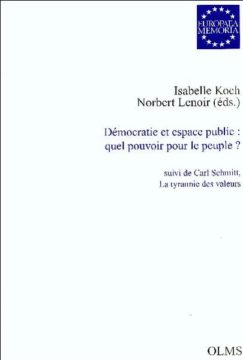
La démocratie est aujourd’hui dans une situation paradoxale: déclarée régime politique indépassable, elle voit parallèlement son concept se rétrécir. Seule une acception étroitement libérale en émerge: la démocratie, enfin ancrée dans le principe de la séparation des pouvoirs, devrait assumer la seule fonction politique de garantie des droits fondamentaux.
Le but de cet ouvrage est de sortir de cette acception étroite, en pensant la démocratie comme une expérience historique, qui commence dès l’Antiquité. Expérience par laquelle la démocratie excédera toujours son simple concept constitutionnel. Analyser les modalités de cet excès, en interrogeant le rapport entre pouvoir du peuple et espace public, fait apparaître le caractère problématique de toute détermination d’un peuple-substance, doté d’une identité fixe. Car, en assignant le peuple à une résidence identitaire, on liquide sa dimension politique: la démocratie ne signifie plus alors que le pouvoir approuvé par le peuple, non le pouvoir du peuple. De ce point de vue, l’histoire de la démocratie moderne est celle d’un oubli actif du principe démocratique – principe du ‚ pouvoir du peuple ‚, du ‚ gouvernement du peuple ‚. Cependant, analyser cet oubli n’est en rien reconduire ce gouvernement au régime idéal de la démocratie directe; c’est le comprendre comme constitution ouverte de sujets politiques qui déplacent les lignes du légitime et de l’illégitime, de l’institué et de l’instituant.
Ces analyses de philosophie politique sont suivies de la traduction d’un texte de Carl Schmitt, La tyrannie des valeurs, inédit jusqu’à présent en français.
Die Demokratie befindet sich heute in einer paradoxen Situation: Einerseits wird sie zur besten aller politischen Ordnungen erklärt, andererseits muss sie mit ansehen, wie ihr Begriff immer mehr eingeengt wird. Nur eine enge, liberale Bedeutung bleibt schließlich übrig: Da die Demokratie ja im Prinzip der Gewaltenteilung verankert sei, habe sie lediglich die politische Aufgabe, die Grundrechte zu garantieren.
Das Ziel dieses Werkes ist es, diese enge Bedeutung zu überwinden, indem man die Demokratie als ein historisches Experiment auffasst, das bereits in der Antike beginnt. Ein Experiment, bei dem die Demokratie stets ihren bloß verfassungsmäßigen Begriff überschreitet. Wenn man die Modalitäten dieser Überschreitung analysiert – indem man nach dem Zusammenhang zwischen der Macht des Volkes und der Öffentlichkeit fragt – so kommt der problematische Charakter jeder Bestimmung des Volkes, als einer mit fester Identität versehenen Substanz, zum Vorschein. Denn wenn man dem Volk eine fest verankerte Identität zuspricht, dann liquidiert man zugleich seine politische Dimension: Die Demokratie bedeutet dann nur noch, dass die Macht vom Volk gebilligt wird, nicht, dass sie von ihm ausgeht. In dieser Hinsicht ist die Geschichte der modernen Demokratie die eines bewussten Vergessens des demokratischen Prinzips – des Prinzips der „Macht des Volkes“, der „Regierung des Volkes“. Doch impliziert eine Untersuchung dieses Vergessens keineswegs einen Rückgriff auf das ideale System der direkten Demokratie: es geht ihr darum, die Demokratie als eine offene Verfassung von politischen Subjekten zu verstehen, die die Grenzen des Legitimen und des Illegitimen, des Eingerichteten und des Einrichtenden verschieben.
Democracy today is caught in a paradox: on the one hand it is acclaimed as the best of all political systems, while on the other its ideas are becoming ever more restricted in scope. There remains only the narrow, liberal interpretation that since democracy is founded on the principle of the separation of powers, its sole political role should be to guarantee fundamental rights.
The aim of this work is to overcome this narrow interpretation by considering democracy as a historical experiment which began in antiquity. An experiment in the course of which democracy will always transcend its simple constitutional idea. If we analyse the modalities of this transcendance – by investigating the relationship between the power of the people and of public opinion – we reveal the problematic nature of any attempt to determine the essence of a nation with a defined identity. For if we attribute a firmly fixed identity to a nation, we simultaneously dissolve its political dimension: democracy comes to mean only that power is sanctioned by the people, not that it comes from them. In this respect the history of modern democracy is a story of the conscious forgetting of the democratic principle – the principle of “power of the people” or “rule by the people”. But analysing this act of forgetting by no means implies the return of this government to an ideal system of direct democracy, but instead signifies an understanding of democracy as an open constitution of political subjects, which shift the boundaries of legitimacy and illegitimacy, of the organised and the organisers.
The volume also contains a French translation of Carl Schmitt’s text, “The Tyranny of Values”, previously available only in German.
- Veröffentlicht am Samstag 1. November 2008 von Olms, Georg
- ISBN: 9783487138909
- 268 Seiten
- Genre: 20., 21. Jahrhundert, Hardcover, Philosophie, Softcover